
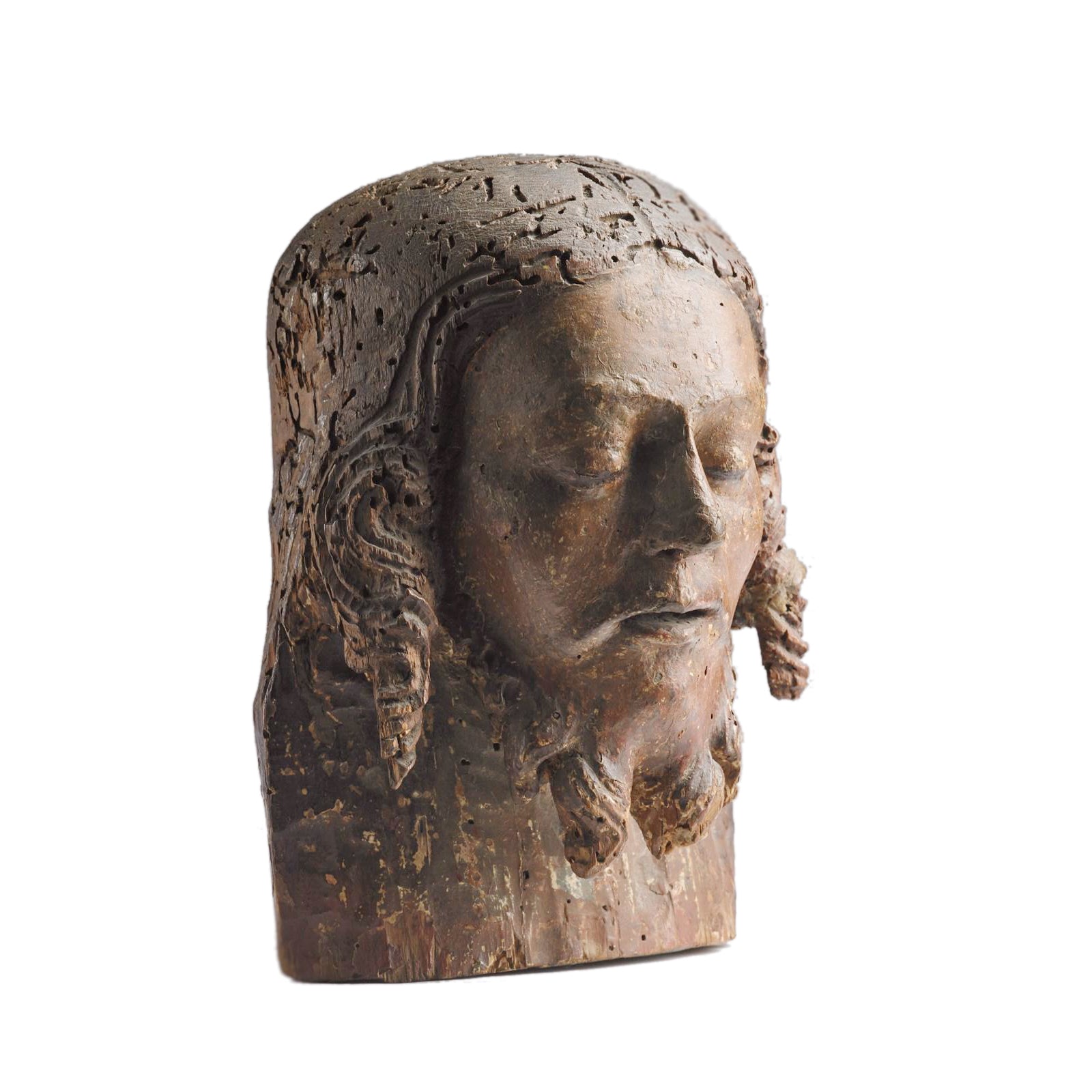
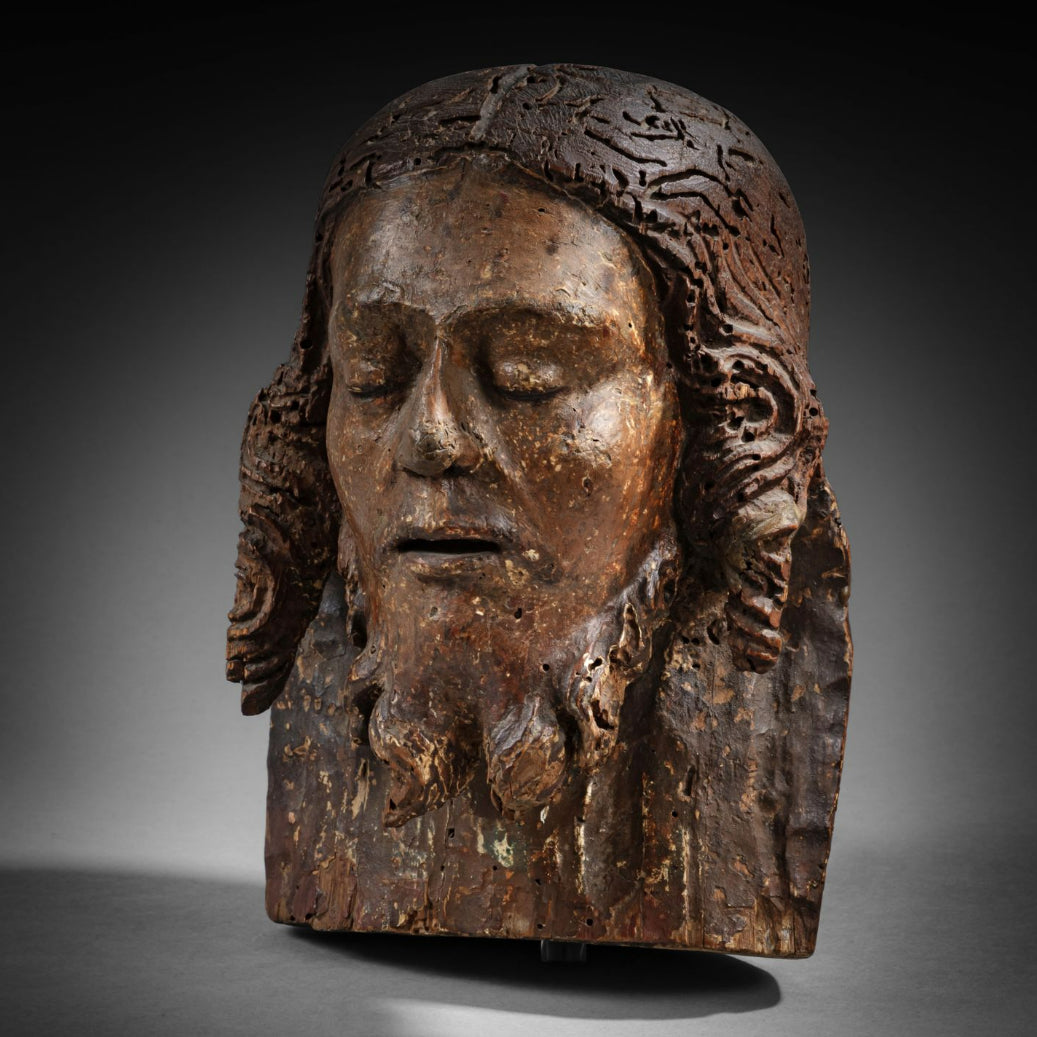


15th C. Florentine Sculpted Wood Head of Christ
In the quiet corners of a 15th-century Florentine oratory, this sculpted head of Christ would have served as the emotional and spiritual anchor of a "Compianto"—a free-standing Lamentation group. Carved during the final third of the Quattrocento, the piece captures the "effigy of Christ expired" with a serene soulfulness that defined the height of the Florentine Renaissance.
The artistry is found in the rhythmic balance of the spiraling tubular curls and the gentle, naturalistic management of the facial features. To hold this fragment is to witness the very moment when medieval devotion met the mathematical grace of humanism. The influence of the Maiano workshop—prolific masters of wood-carving along Via de' Servi—is evident in the sophisticated profile and the traces of painted stucco that once gave the wood the "incarnation" of living flesh.
For the cultural collector or elite interior designer, this head is more than a religious artifact; it is a sculptural anchor. It brings the intellectual weight of 1470s Florence into the contemporary home, offering a presence that is at once haunting, beautiful, and profoundly permanent. It is a testament to the "Lineage of the Room," signaling a commitment to museum-quality stewardship.
Specifications:
Origin: Florence, Italy
Period: Late 15th Century (ca. 1470–1490)
Style: Florentine Renaissance (Early Quattrocento)
Material: Hand-carved solid wood with traces of polychrome and gesso-stucco modeling.
Dimensions: 16 x 24 x 6 cm
Condition: Antique condition as a fragment. Notable authentic patina and centuries of devotional wear. Traces of original stucco-modeled hair remain. Variable traces of old worming in the wood.
Historian’s Note:
This head is likely a rare survival of a "Compianto" group, where a supine figure of Christ was surrounded by life-sized mourners. In 15th-century Florence, wood-carvers were more numerous than butchers—a testament to the city's obsession with sacred art. This piece aligns with the "verism" popularized by the Maiano and Sangallo dynasties. The specific "corkscrew" carving of the beard suggests a closeness to the ambit of Benedetto da Maiano, whose workshop was the epicenter of Florentine liturgical woodwork. Such fragments are highly prized by institutions like the Metropolitan Museum of Art, as they represent the shift toward the "naturalism of the soul" in Renaissance sculpture.
Choose options