
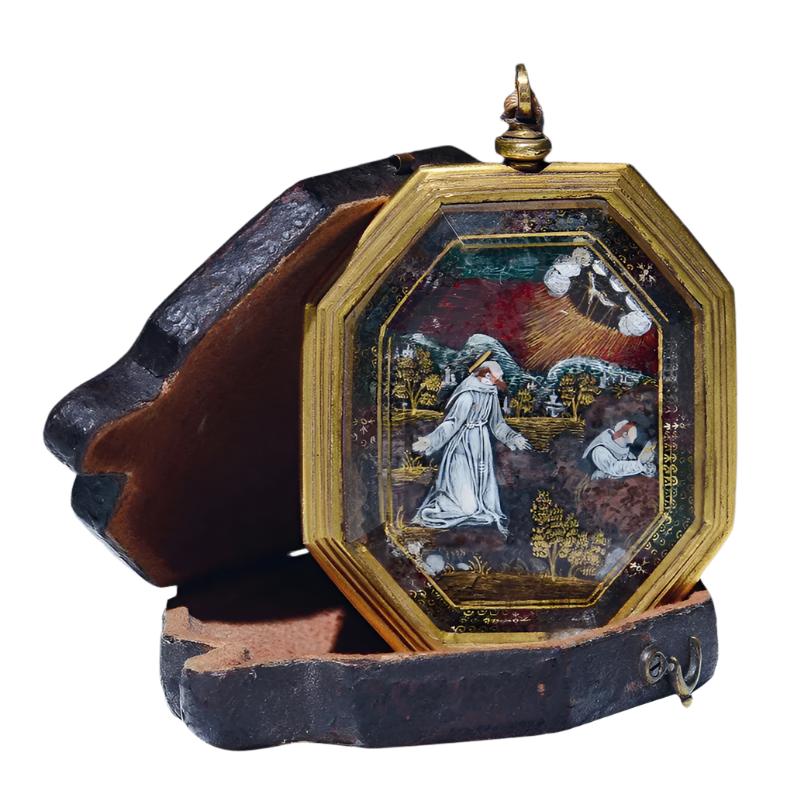
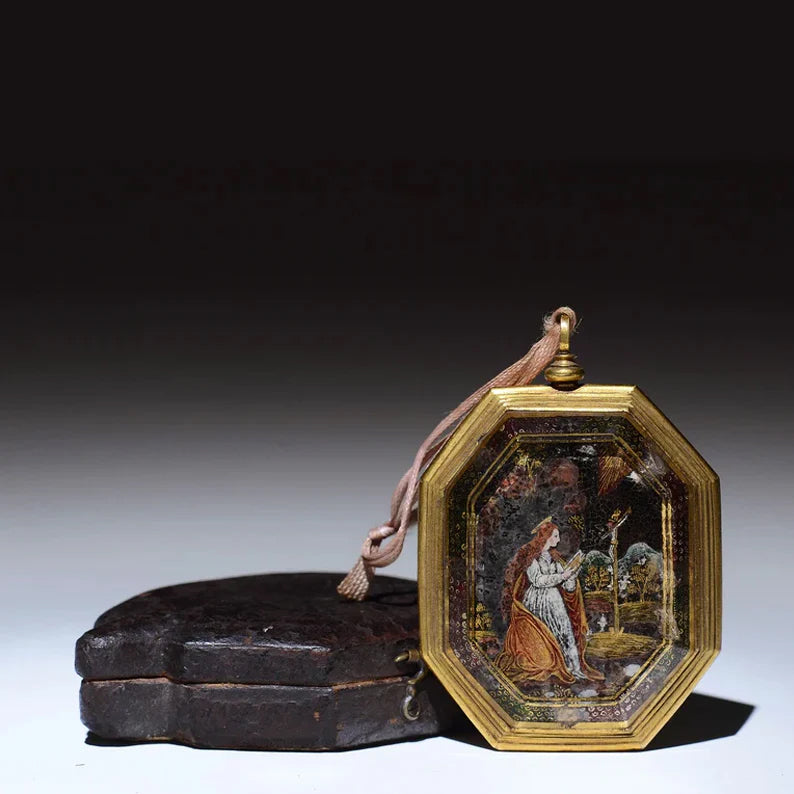

16th C. Verre Églomisé Pendant | St. Francis & St. Clare
In the private world of 16th-century European nobility, faith was often worn close to the heart, encapsulated in treasures of breathtaking fragility. This rare Renaissance devotional pendant is an exquisite example of verre églomisé—the ancient art of gilding and painting on the reverse side of glass, or more specifically: rock crystal.
One side of this devotional pendant reveals the gentle countenance of St. Francis of Assisi, while the other features St. Clare, both rendered with a delicate, ethereal glow that only gold leaf on crystal can achieve. To hold this piece is to feel the weight of five centuries of prayer and history. The masterful use of negative space and fine painting reflects the sophisticated artistic sensibilities of the High Renaissance in Italy.
Suspended in its original, or period-commensurate, frame, this pendant is not only jewelry; it is a historical document. For the cultural collector or the interior enthusiast seeking to imbue a space with "Quiet Luxury" and intellectual depth, this relic offers an unparalleled connection to the spiritual lineage of Europe. It is an investment in beauty that has survived the passage of time with grace.
Specifications:
Origin: Milan, Italy
Period: 16th Century (ca. 1530s)
Style: Attributed to Giovanni Giacomo da Decio or his immediate ambit
Material: Verre églomisé (gilded and engraved glass), metal mounting.
Dimensions: 9.5 x 6.5 cm
Condition: Excellent antique condition for its age and fragility. The gilded imagery remains remarkably legible with an authentic, soft patina to gilt bronze mount.
Historian’s Note:
The technique of verre églomisé seen in this pendant reached a zenith of popularity during the 16th century, particularly in Northern Italy. The process—applying gold or silver leaf to the back of glass and then scratching away a design with a needle—required immense precision, as a single error would shatter the visual narrative. These pendants were often commissioned by elite patrons as tokens of protection or "memento mori." The pairing of St. Francis and St. Clare is significant, representing the dual pillars of the Franciscan order and the profound spiritual friendship that defined 13th-century Assisi—a theme that resonated deeply with the humanist values of the Renaissance era.
Choose options