
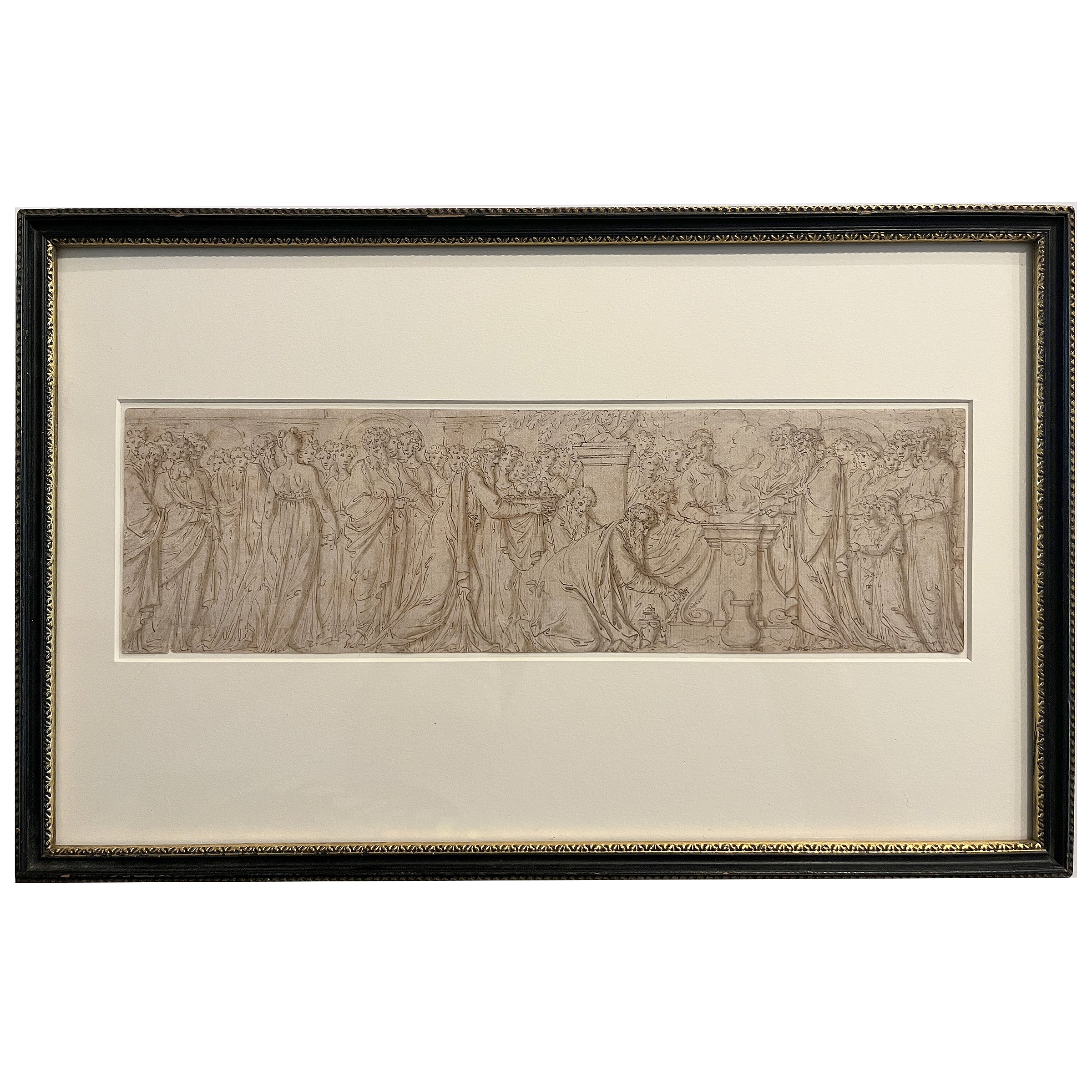



Louis-Félix de La Rue 18th C. Classical Altar Drawing
To possess a drawing by Louis-Félix de La Rue is to hold a fragment of the French Enlightenment’s fascination with the classical soul. This original 18th-century work—a fluid, masterful study of figures gathered around a sacrificial altar—transports the viewer to the height of the Neoclassical movement in Paris.
De La Rue, a Prix de Rome winner and a contemporary of Boucher, was celebrated for his ability to translate the static weight of ancient Roman sculpture into the lyrical movement of the pen. In this piece, the "lineage of the stroke" is visible; you can see the urgency and precision of a master draughtsman capturing the architectural rhythm of a classical relief. The interplay of light and shadow, rendered in delicate washes, creates an atmosphere of timeless gravitas.
Housed in a refined period-correct frame, this drawing serves as a "sculptural anchor" for a room. It is not simply wall decor; it is a scholarly statement. For the interior designer or cultural collector, it offers that elusive "settled purpose" that only an object with a 250-year-old pulse can provide. It is a work of integrity, intended for a home that values the permanence of master craftsmanship over the fleeting nature of the modern trend.
Specifications:
Origin: France (Paris)
Period: mid-18th Century (ca. 1750–1765)
Style: French Neoclassical / Classical Revival
Material: Ink and wash on paper; professionally matted and framed in a period-style giltwood frame.
Dimensions: [Insert Dimensions from Old World Wonders, e.g., 12” x 15” Framed]
Condition: Excellent antique condition. The paper retains its original integrity with minimal foxing consistent with age, enhancing its authentic historical character.
Delivery: Complimentary shipping within the USA is included in price.
Historian’s Note:
Louis-Félix de La Rue (1731–1765) was a pivotal figure in the French Royal Academy, earning the prestigious Prix de Rome in 1754. His work represents a crucial bridge between the ornate Rococo of his mentor, François Boucher, and the rigorous Neoclassicism that would soon define the era of Louis XVI. This particular drawing likely dates to his residency in Rome or his subsequent return to Paris, where he became renowned for his "Bacchanalian" and "Classical Sacrifice" scenes. Collectors prize De La Rue for his rare ability to imbue classical themes with a sense of "vif" (liveliness), making his drawings highly sought after by institutions such as the Metropolitan Museum of Art and the British Museum.
Choose options