
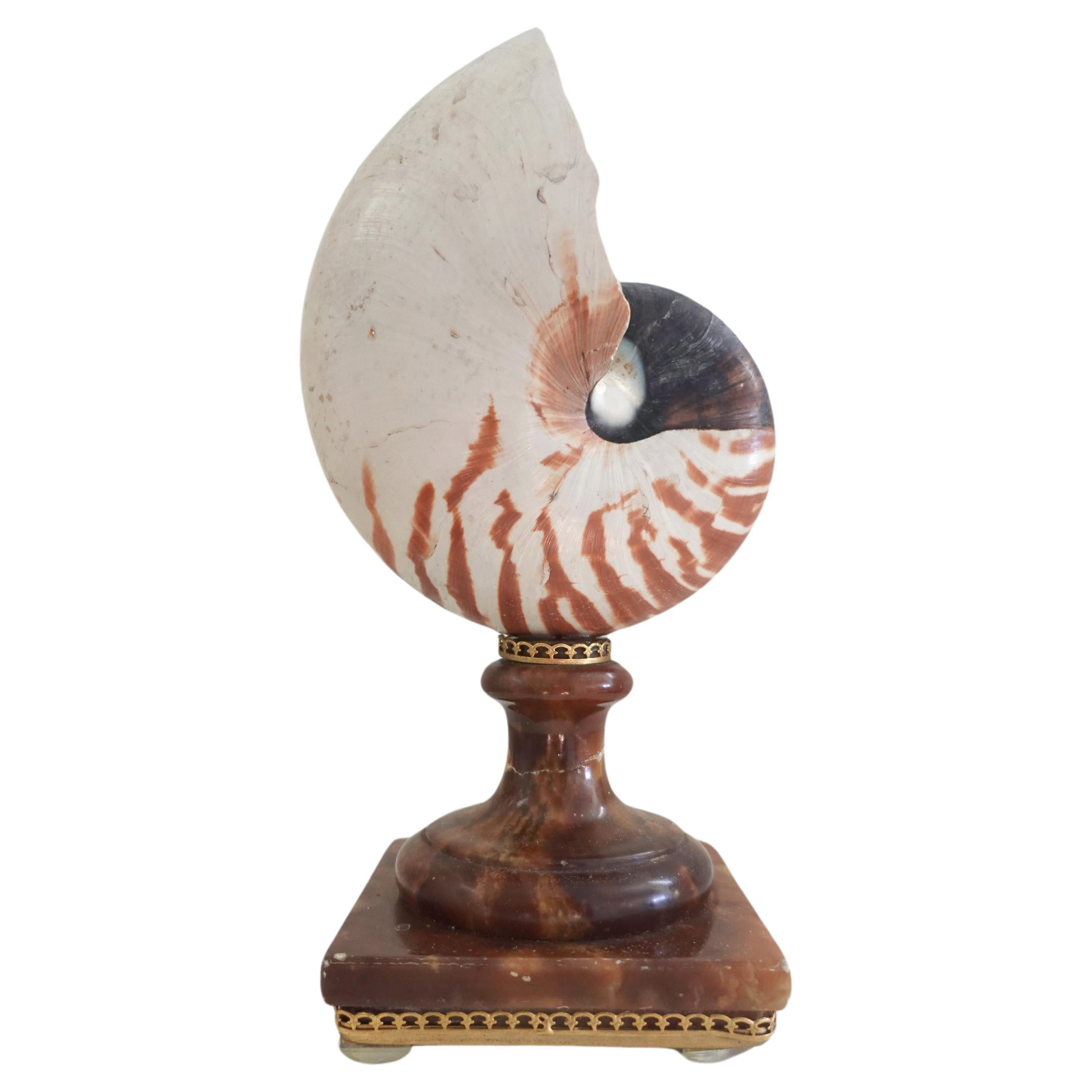
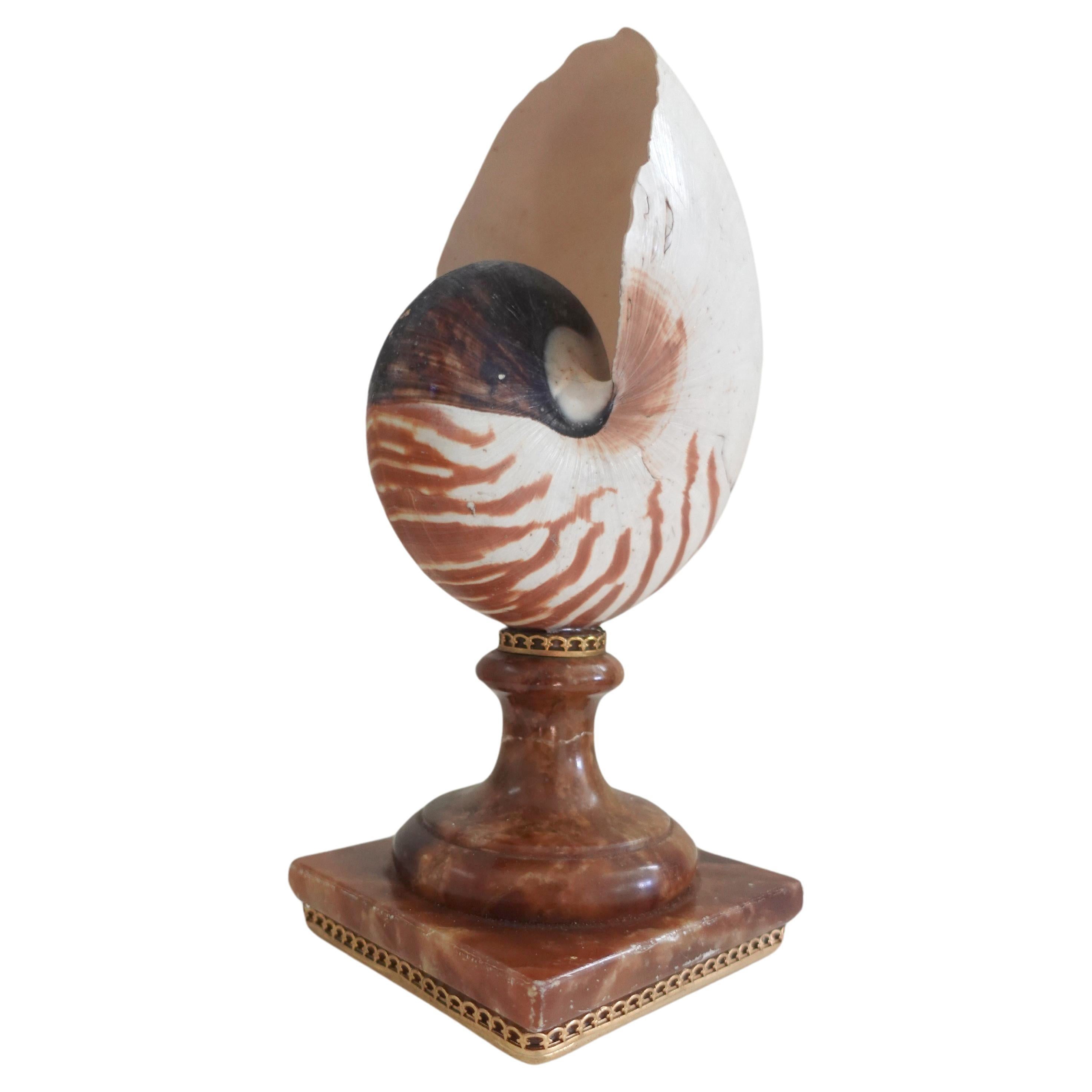


Vintage Nautilus Shell on Sicilian Alabaster Base
In the traditional European "Wunderkammer" or Cabinet of Curiosities, the Nautilus shell was the ultimate symbol of the divine geometry found in nature. This exceptional vintage piece—a fully chambered Nautilus Pompilius—is a sculptural testament to that legacy. Mounted upon a substantial base of Sicilian alabaster, the shell represents a dialogue between the depths of the Indo-Pacific and the storied quarries of Italy.
The shell itself is a marvel of architectural precision, showcasing the logarithmic spiral that has captivated scientists and artists from Aristotle to the Renaissance masters. Its pearlescent interior and striped tiger-patterned exterior provide a tactile contrast to the cool, luminous weight of the vintage alabaster. The base, repurposed from a mid-20th-century Sicilian lamp, features openwork gilt metal trim, lending a touch of mid-century European glamour to a timeless natural wonder.
For the interior designer or cultural collector, this mount serves as a "sculptural anchor." It is an object that bridges the gap between the organic and the man-made, offering a sense of "The Measured Life" to a desk, mantle, or library shelf. It is a piece for a home that values the Lineage of the Room, where every object is chosen for its integrity and its story.
Specifications:
Origin: Shell (Philippines); Base (Sicily, Italy)
Period: Second-half of the 20th Century (Vintage)
Style: Natural History / Curiosity Cabinet / Neo-Classical
Material: Genuine Nautilus Pompilius Shell, Sicilian Alabaster, Gilt Metal
Dimensions: Approx. 11” (h) x 4” (w) x 4” (d)
Condition: Vintage condition. The shell remains "straight from nature" with minor organic fissures. The alabaster base exhibits an authentic patina with minor nicks consistent with age, including a historic, stable repair.
Historian’s Note:
The Nautilus shell has been a cornerstone of European "Naturalia" collections since the 16th century. During the Age of Discovery, these shells were prized not just for their beauty, but as "mysterious sea treasures" that arrived in Europe via the Spice Trade. In Germany and the Netherlands, they were often mounted in silver-gilt to create extravagant "Nautilus Cups." This specific pairing with Sicilian alabaster is a nod to the 18th and 19th-century tradition of Grand Tour souvenirs, where natural wonders were elevated by the craftsmanship of Mediterranean stone-cutters. It represents the Enlightenment ideal: the human desire to categorize, frame, and admire the infinite complexity of the natural world.
Choose options